


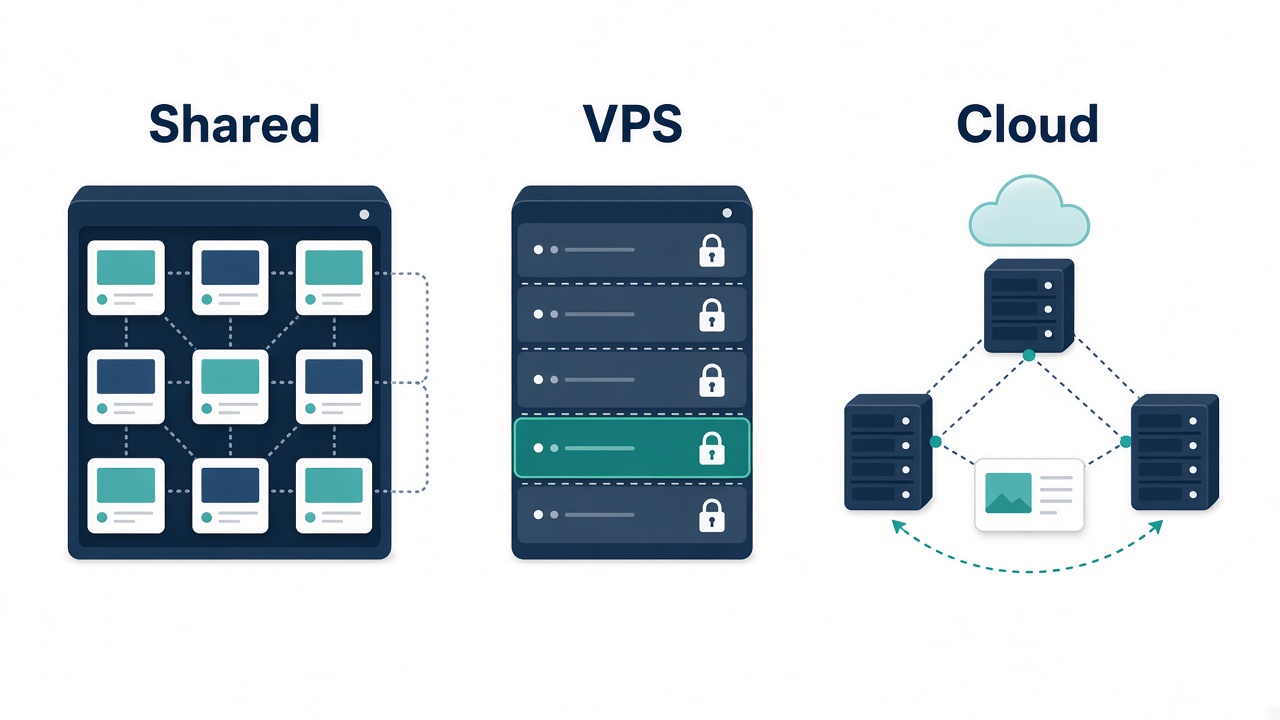
Sales pages use the same three names for very different machines. Shared hosting vs VPS vs cloud is the decision about which limit you are paying to remove, for a site you have now or are about to launch. Buyers in Pakistan, the UAE, and elsewhere face that choice, then a local bill and a server that may sit far from their visitors. Nothing here ranks one provider above another. The next section matches the site to one model. What follows tests the plan label, the renewal, and the region before any payment.
Which hosting model fits your website?
Choose shared hosting for a simple site with steady traffic and no server work. Choose a VPS for reserved resources at a fixed monthly cost. Choose cloud hosting when demand swings sharply and capacity can be added without a full move. Use the smallest model that covers the limit you hit.
Situation | Model | Why |
Simple site, steady demand, no one to manage a server | Shared hosting | The host runs the server and the workload is light |
Reserved resources and a bill you can predict | VPS | The allocation and the monthly price stay fixed |
Demand swings hard, and an outage at the peak costs sales | Cloud hosting | Capacity can change without rebuilding the site on a new machine |
The app needs a software version the shared platform will not allow | VPS or cloud | A larger shared plan cannot change that platform limit |
Match the row to this month. Brochures and new blogs use the first. A shop that needs a steady allotment uses the second. Large, irregular peaks that lose orders use the third. The fourth is software the platform will not run. A planned short sale is answered with scaling below.
How shared hosting, a VPS and cloud hosting work
How the server is divided decides who can change it, and what a hardware failure does.
What shared hosting gives you
Many accounts draw on one server’s processor, memory, and disk. The provider maintains the operating system and the panel. You publish files and install WordPress in that panel. Root access is not included. A busy or compromised neighbour can slow the other accounts.
What a VPS gives you
Virtualisation divides one physical server into separate machines. The plan reserves cores, memory, and storage, and it can run its own operating system. Root access, where included, lets you install software the shared platform blocks. Other virtual machines still share that server, its disks, and its network port. The reserve protects your memory allotment. It does not make the hardware yours alone.
What cloud hosting gives you
The workload can come from a pool of machines. The site moves only if another machine is ready. A known short peak can be covered by a larger fixed plan, or by a resize booked in advance. Cloud hosting fits large or repeated swings, when capacity can be added without a rebuild.
Shared hosting | VPS | Cloud hosting | |
Resource assignment | Pooled on one server | Reserved on one server | Drawn from a pool, if the platform is built that way |
How it scales | Move to another plan | Resize, often with a restart | Add capacity, sometimes while the site stays online |
If that hardware fails | Down until the machine is restored | Down until that machine is restored | Stays up only if another machine can take the work |
Who can change the server | The host | You, if the plan includes root access | You or the host, depending on the product |
How to tell which model a plan really is

Six questions separate a shared account, a fixed VPS, and cloud hosting that can grow.
Are the CPU and RAM reserved, or fair-use limits on a shared box?
Does the account have its own operating system and root access?
Can the provider move or expand the site, or does it sit on one machine?
Does adding resources take a reboot, a migration, or a live change?
At the limit, does the site slow down, return an error, or get suspended?
Is the bill fixed, or does usage change it?
Reserved resources and no root access mean a managed account. Its own operating system and root access mean a VPS. A live increase across machines, with a bill that can change with use, means scalable cloud hosting.
HostCry’s pages make the gap concrete. Shared plans are cPanel accounts on CloudLinux. VPS plans are KVM machines with root access. The cloud plans are cPanel accounts with CPU and RAM set in the plan, not servers and databases you assemble yourself. A panel-based cloud plan can still suit a busy site. It is not hyperscale cloud.
What to settle for visitors in Pakistan, the UAE, or another country

Five checks sit outside the architecture, for visitors in Pakistan, the UAE, and further away.
Currency. Ask whether the renewal is in Pakistani rupees or US dollars. A dollar price moves with the exchange rate. A rupee price does not.
Payment method. HostCry’s Pakistan checkout currently takes EasyPaisa, JazzCash, bank transfer, and cards, in rupees. Confirm the list on the day you pay. A buyer in the UAE for VPS Hosting, or elsewhere, needs a method that works in that country. A Pakistani mobile wallet is not a UAE payment method.
Invoice. If the business records the fee, ask for an invoice in the business name. The model does not set the tax treatment, and this page states no tax rate.
Server region. Visitors in Pakistan and the UAE wait longer when the machine is far away. Ask which city or country holds the server for the product you are buying. HostCry’s public pages do not give one location for every plan. Treat the region as unconfirmed until you have it for that plan.
Support and the domain. Ask which hours the team answers, and in which language. HostCry’s pages currently offer Urdu and English. A .pk name is registered with PKNIC, the .pk registry, or through one of its resellers. PKNIC runs that namespace and does not host websites. Changing the hosting model does not move that registration.
What actually changes the price
The headline fee is only the start. Compare the renewal, the currency, a control-panel licence, backups, a management fee, and any charge for bandwidth or a public IP address. A fixed VPS is easier to forecast. Usage-based cloud can cost less in a quiet month and much more after a spike, a bot flood, or a service nobody turned off.
Shared hosting is usually the lowest fixed fee, because many accounts divide one server. A VPS costs more because the cores and memory are held for you. Cloud hosting is sometimes a fixed plan and sometimes a bill that follows use.
Place the first term beside the renewal. HostCry’s shared hosting page shows a renewal above the signup price. The cloud hosting page says the cloud price does not change. VPS hosting is sold as a monthly PKR plan. Re-read all three on the day you order. Cards, specification tables, and the homepage can disagree. If they do, the checkout total is the price.
Skip anyone else’s price bands. A cheap plan with a tight cap, and a cloud account with no spending alert, can both finish above the number in the advert.
When a slow website needs a new plan
Move when the host is enforcing a resource limit, or when the platform cannot supply software the site needs. Stay when the pages themselves are heavy or a plugin is slow. Read the error and the resource graph before you change products. Two or more true limit signals, after the site has been trimmed, are enough reason to plan a move.
Limits that mean the plan is too small
A processor or entry-process cap that returns in ordinary busy hours is a hosting limit. Entry processes are the PHP tasks the account may run at once. Scripts killed mid-run, HTTP 503 errors on real visits, inode or I/O caps, and a PHP version or database the platform refuses belong with them.
HostCry’s shared specification table is one such row. At the time of writing it lists 20 entry processes and a 2 MB/s I/O limit, plus a monthly bandwidth figure. Read the live table. A bandwidth number means the plan is not unlimited.
Speed problems that survive an upgrade
Large images, too many plugins, no page cache, a heavy theme, and outside scripts stay slow after an upgrade. Weigh one slow page before you accept a bigger plan.
Who should manage the server
Choose managed hosting when nobody on the team can update the operating system, restore a backup, and read an error log this week. Choose unmanaged hosting when a developer can do that work and the lower server fee is worth their time. An unmanaged server with nobody looking after it becomes an outage and an open door.
On a managed plan the host patches, watches, and restores the system. On an unmanaged plan that work is yours or a freelancer’s. The site and the application stay yours either way. Managed WordPress is a service layer on shared hosting or a VPS, not another kind of machine.
On the VPS product above, you keep the system work. Support can help with setup questions. cPanel or Plesk needs your own licence. A backup you have never restored is unfinished. Add the freelancer’s time, and get that rate in writing, before you treat the unmanaged fee as the full cost.
What to confirm before you buy
Five lines on the order page matter more than the product badge.
Processor, memory, process limits, disk, and bandwidth are written down.
The region is named, and so is the path to more resources.
A restore is described, including how long it takes.
A move says whether files, databases, and mail are included.
Renewal term, currency, and the cancel point are visible before you pay.
If a limit is missing, ask for it in writing before a long term is paid. HostCry’s shared page says the account opens when payment clears, and that staff can move files, websites, and databases at no extra charge in most cases. Duration follows the size of the data. WhatsApp support is offered before and after the order when a line is unclear. Ignore a zero-downtime slogan. Plan from the sentence that ties the job to the amount of data.
Compare the checkout with the limit you already found
Pay only when the checkout total, the server region, and the renewal currency match what you were shown. A page can use an accurate product name and still renew in another currency, or place the machine farther from your visitors than you expected. Score shared hosting vs VPS vs cloud at that checkout, on the plans HostCry publishes, and leave the current host alone until those three items agree.